Mushrooms After Forestry Mulching in Naples: Why This Is Actually a Good Sign for Your Land
- PRIMUS Land Clearing

- Jan 27
- 4 min read
After forestry mulching, land often looks finished — clean, reset, quiet.It feels like the work is done.
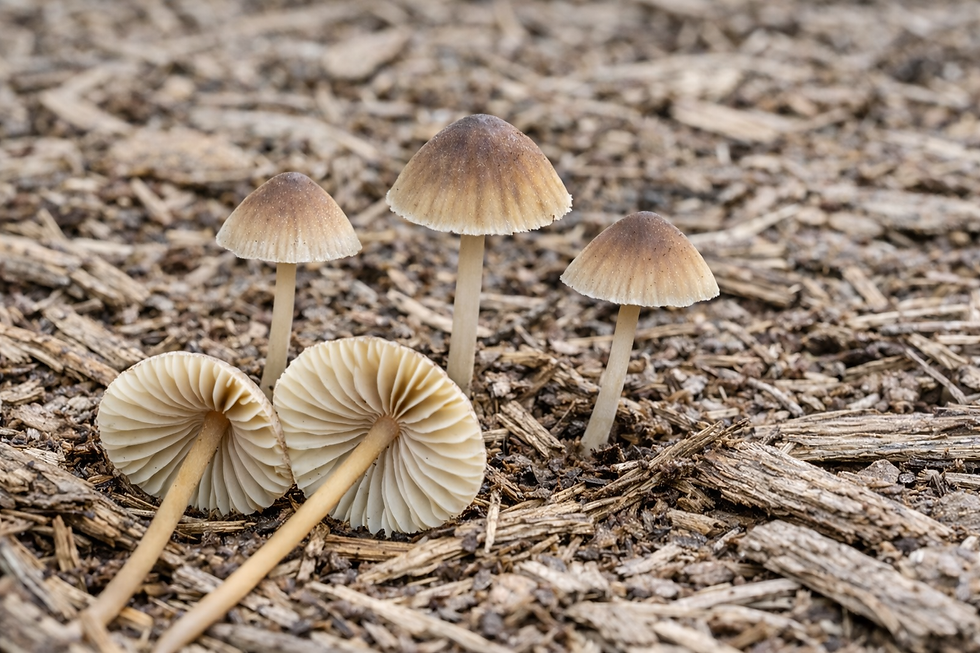
Then, a few weeks later, small mushrooms appear across the mulched surface. Many property owners in Naples notice them and immediately assume something went wrong: excess moisture, decay, or a mistake during clearing.
That assumption is understandable. It’s also usually incorrect.
Mushrooms after forestry mulching in Naples are not a warning sign. They indicate that the land has entered its next phase — one that happens quietly below the surface and determines how stable and manageable the property will become over time.
Forestry Mulching Changes How the Land Functions
Forestry mulching doesn’t remove vegetation from a property. It transforms it.
Trees, brush, vines, and undergrowth are converted into a thin layer of organic material that rests directly on the soil. Once the equipment leaves, the mechanical work ends — but the biological work begins.
This transition isn’t dramatic. There’s no visible movement, no sudden shift. Yet beneath the surface, the land moves from a mechanical state into a biological one. Mushrooms are often the first visible sign that this process is already underway.
Why Mushrooms Appear After Forestry Mulching in Naples
Wood resists decomposition because it contains lignin, the compound that gives trees and brush their strength. Most bacteria struggle to break lignin down efficiently.
Fungi don’t.
In the warm, humid conditions typical of Naples and Bonita Springs, fungal activity accelerates quickly — especially when fresh organic material and periodic rainfall are present. The mushrooms that appear are not the process itself; they are simply the visible expression of decomposition already happening underground.
By the time mushrooms become noticeable, breakdown is well underway. On properly mulched properties, they often appear briefly after rain and fade naturally as the surface stabilizes.
The Mistake Most Property Owners Make
Mushrooms are easy to associate with decay or neglect. Visually, that conclusion makes sense.
The mistake is expecting land to remain inactive after clearing. In reality, inactive land is often unstable land. Healthy soil systems remain biologically active, even when the surface looks calm.
Mushrooms indicate that organic material is being processed rather than stagnating, moisture is cycling instead of pooling, and the soil system is beginning to regulate itself.
Why Interfering Often Makes Things Worse
Some property owners try to remove mushrooms, rake disturbed areas, or apply treatments in an attempt to “dry things out.”
This usually backfires.
Disrupting fungal activity slows decomposition unevenly. Nutrients stop releasing gradually and instead enter the soil in irregular bursts — a pattern that often leads to faster, more aggressive regrowth later on.
The issue isn’t the mushrooms themselves. It’s reacting to them without understanding what they represent.
What Mushroom Activity Is Quietly Doing for Your Land
As fungi continue breaking down the mulched material, several important changes take place.
The mulch layer becomes finer and more uniform. Moisture distributes more evenly across the surface instead of collecting in isolated areas. Nutrients are released slowly, supporting controlled regrowth rather than chaotic vegetation spikes.
These processes aren’t immediately visible, but they are the difference between land that becomes easier to manage over time and land that turns into a recurring problem.
Why You May Have Never Seen This Before
Many property owners say they’ve owned their land for years without ever seeing mushrooms.
That’s common.
Before mulching, organic material stood upright. Decomposition happened slowly and mostly out of sight. After forestry mulching, that same material is spread across the soil surface, where moisture, oxygen, and biology can interact efficiently.
The fungi didn’t suddenly appear.They simply became visible.
When Mushroom Growth Is Normal — and When Context Matters
In most cases, mushrooms appear briefly after rain and disappear on their own. No treatment is required, and no action is necessary.
Only in specific situations — such as unusually thick mulch layers that remain constantly wet, or land scheduled for immediate construction — does timing or surface management become relevant. Even then, it’s a matter of planning, not failure.
Should Mushrooms Be Treated or Removed?
No.
Treating mushrooms addresses appearance, not function. Time, drying cycles, and natural biological processes regulate the system far more effectively than any chemical intervention.
The Bigger Picture
Mushrooms after forestry mulching in Naples signal efficient organic breakdown, natural moisture regulation, and a property moving toward long-term stability.
They are temporary. They are expected. And in most cases, they are a good sign.
They don’t guarantee perfect soil conditions on their own, but they do confirm that the biological groundwork is being laid correctly. Long-term results still depend on how the land is used and managed afterward.
Mushroom growth is just one part of a larger sequence the land moves through after clearing. For a broader look at what happens from surface reset through long-term stabilization, we outline the full post-mulching process in What Happens After Forestry Mulching?
Real land-clearing expertise doesn’t end when equipment shuts down. It shows in understanding what happens next — quietly, steadily, and often misunderstood.
That understanding is what leads to better land decisions.


Comments