What Happens After Forestry Mulching?

Updated: Feb 13
The 4 Biological Phases That Determine Whether Cleared Land Stabilizes or Becomes Problematic

This article explains what happens after forestry mulching in Florida and why the period following clearing determines whether land becomes stable, manageable, and predictable — or problematic later on.
What happens after forestry mulching is rarely discussed, even though it determines whether cleared land becomes stable, usable, and predictable — or requires correction months later.
A property may look finished immediately after the work is complete.In reality, the most important changes begin beneath the mulch layer.
Forestry mulching does not end a process. It initiates one.
In Florida’s climate, forestry mulching in Florida behaves differently than in cooler regions due to heat, humidity, and rapid biological activity.
Understanding these post-mulching transitions allows property owners to make informed decisions about expectations, drainage behavior, regrowth, and long-term land use.
Forestry Mulching Does Not Remove Material — It Redistributes It
Forestry mulching does not export organic material from the site. It transforms standing vegetation into a distributed surface layer.
That distinction matters.
Instead of roots anchoring stems above ground, woody material now rests in direct contact with soil. From that moment forward, the land is no longer reacting to machinery. It begins responding to:
moisture
microbial activity
gravity
temperature
decomposition
The shift is quiet. There is no dramatic visual change. But below the surface, biological processes begin adjusting immediately.
The 4 Phases Land Moves Through After Forestry Mulching
Land does not stabilize instantly. It moves through a sequence of predictable phases.
When allowed to progress naturally, these phases tend to produce more stable and manageable outcomes over time.
Phase 1: Immediate Surface Reset
Right after forestry mulching, the ground often appears uniform and calm.
The mulch layer:
shields soil from direct sun
reduces rapid moisture loss
limits surface erosion
buffers temperature swings
At the same time, the soil underneath begins adjusting to new conditions:
root pressure is gone
water flow paths shift
sunlight exposure changes
organic matter now rests directly on the soil surface
Nothing dramatic is visible yet —but the reset has begun.
Phase 2: Moisture Regulation and Settling
As rainfall and humidity interact with the mulch layer, water movement slows and redistributes more evenly.
Instead of running off exposed soil, moisture is absorbed, retained, and released gradually.
During this period:
minor uneven settling may occur
softer zones may temporarily develop
drainage behavior may appear different than before clearing
This is often mistaken for instability.
In most cases, it is simply the land recalibrating.
Temporary settling after forestry mulching is typically a moisture-response phase, not structural failure.
Florida’s frequent rainfall and humidity often accelerate this adjustment phase.
Phase 3: Biological Activity Accelerates
Once moisture and temperature align, biological systems activate.
Microorganisms and fungi begin breaking down woody material within the mulch layer.
This decomposition process:
converts coarse mulch into finer organic matter
gradually releases nutrients
improves surface soil structure
enhances microbial diversity
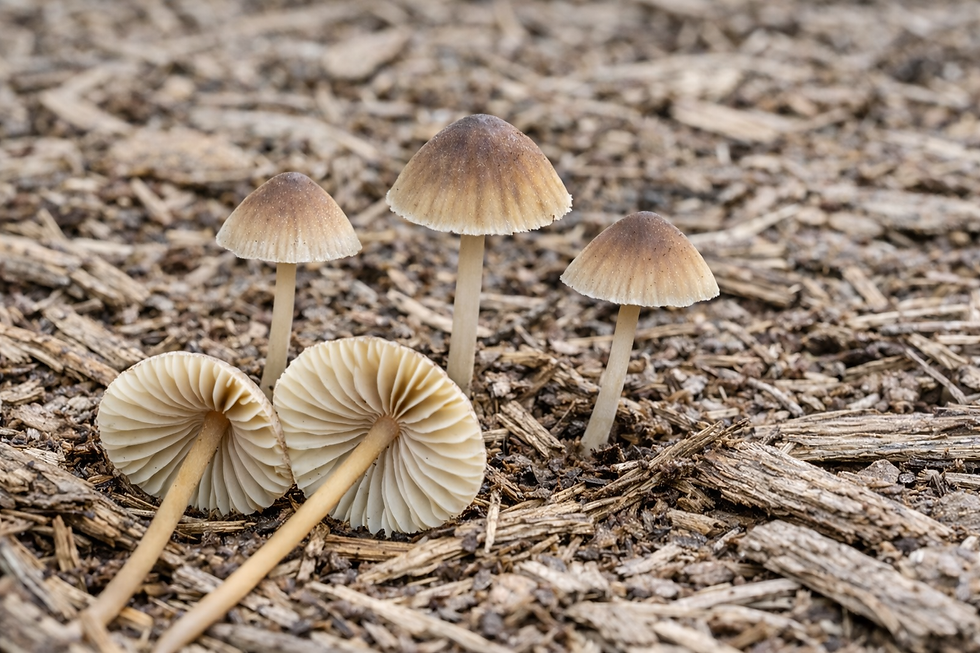
During this phase, biological activity often becomes visible — most commonly through small mushrooms appearing in the mulch layer after rainfall. For many property owners, this raises questions. We explain why this is usually a positive sign in detail here:
Florida’s warm climate accelerates this biological activity compared to cooler regions.
Phase 4: Stabilization and Predictable Ground Behavior
As decomposition progresses, the land transitions into a more stable state.
Moisture patterns normalize. Mulch integrates into upper soil layers. Surface movement slows.
Property owners often notice:
fewer erosion issues
more controlled regrowth
improved surface consistency
easier long-term maintenance
At this stage, the land is no longer adjusting. It has stabilized.
A Common Misconception: Mulching “Finishes” the Property
One of the most persistent misunderstandings is that forestry mulching permanently eliminates vegetation.
It does not.
Forestry mulching resets land conditions. It does not freeze ecological processes.
Regrowth over months and years is natural and expected. Many property owners ask whether this means mulching “failed.” In reality, regrowth patterns depend heavily on how forestry mulching in Florida is integrated into a long-term land management plan.
Mulching establishes a foundation. Management determines what follows.
When Post-Mulching Conditions Deserve Attention
In most cases, the four phases described above unfold quietly and resolve on their own. No intervention is required.
Context matters only in specific situations, such as unusually thick mulch layers, consistently poor drainage, or immediate plans for turf or construction. These are not failures of forestry mulching. They are planning considerations tied to how the land will be used next.
The Bigger Picture
What happens after forestry mulching determines whether cleared land becomes stable, manageable, and predictable — or requires ongoing correction.
The ground settles. Moisture redistributes. Biology activates. Stability develops.
This process takes time. That time is not wasted. It is structural.
If you're considering forestry mulching in Florida, understanding what happens afterward is just as important as the clearing itself.
At PRIMUS Land Clearing, we approach forestry mulching not as a one-day mechanical event, but as the beginning of a biological transition.
Professional land clearing does not end when the machines leave.It includes understanding how the land behaves afterward — and setting expectations accordingly.


Comments